Every founder I've met this year has a boat. Almost none of them have a compass.
Five hundred years ago, the same thing was true. A few traders said enough is enough and went looking for new land anyway. Some died at sea. Some rounded the Cape of Good Hope. A few stumbled into the Americas and India.
They all sailed for the same reason. Money. But one thing was constant. In uncharted territory, only the boldest get to make the bet.
Columbus pitched four courts over seven years before Isabella funded him. In 1494, Portugal and Spain drew a line down the unknown world and split it. Most expeditions failed. The survivors changed civilization.
Those traders were the proto-VCs. A century later, the joint-stock company made it a market. VOC. East India. Tradable shares, distributed risk, returns to the financier. The sailor got a wage and a story.
The compass and the astrolabe were the stack. The map was the product.
Two kinds of people made money on those voyages. The first built the compass, the astrolabe, the sails. The second landed on Australia, on India, on the Americas. Both alphas were real. One rewrote civilization.
Most of what I see being built today is the compass. Reliability layers, routing protocols, identity gateways. Honest work, and it pays. See §13, where most of the visible market sits. But it is not the land. The land is the businesses and structures of value that only exist once agents are common. We have come roughly to the Cape of Good Hope. We are not at Australia.
Today everyone is making a bet again. The sailors are out there, but most are hugging the coast and calling nearby islands new lands. Very few are charting the actual distance. Very few are saying this is the uncharted. Here's my compass, here's my map, here's what I think is on the other side.
This is the AI age. Nobody knows where it's heading. Every founder and every VC is trying to draw a parallel that makes the territory legible.
This is the parallel that makes sense to me.
If you are reading this, you probably have one of seven questions. Where are things heading. What the model labs actually see. Whether the Chinese and American labs are even in the same race. Where the opportunity is. What the next choke point will be. Why a company that started four months ago just raised thirty million dollars. And how a few people seem to be six months ahead of everyone else.
I will try to answer all seven. The panel on the right is the index. Click the question you came in with and the section that answers it lights up. If the answer is not where you expected, tell it — not yet — and it will point you to the next place.
Some of what these few people see is planning. Most of it is positioning. The difference matters less than you would think. What matters is the picture they are positioning against. That picture is what the rest of this is about.
Before the map, the field.
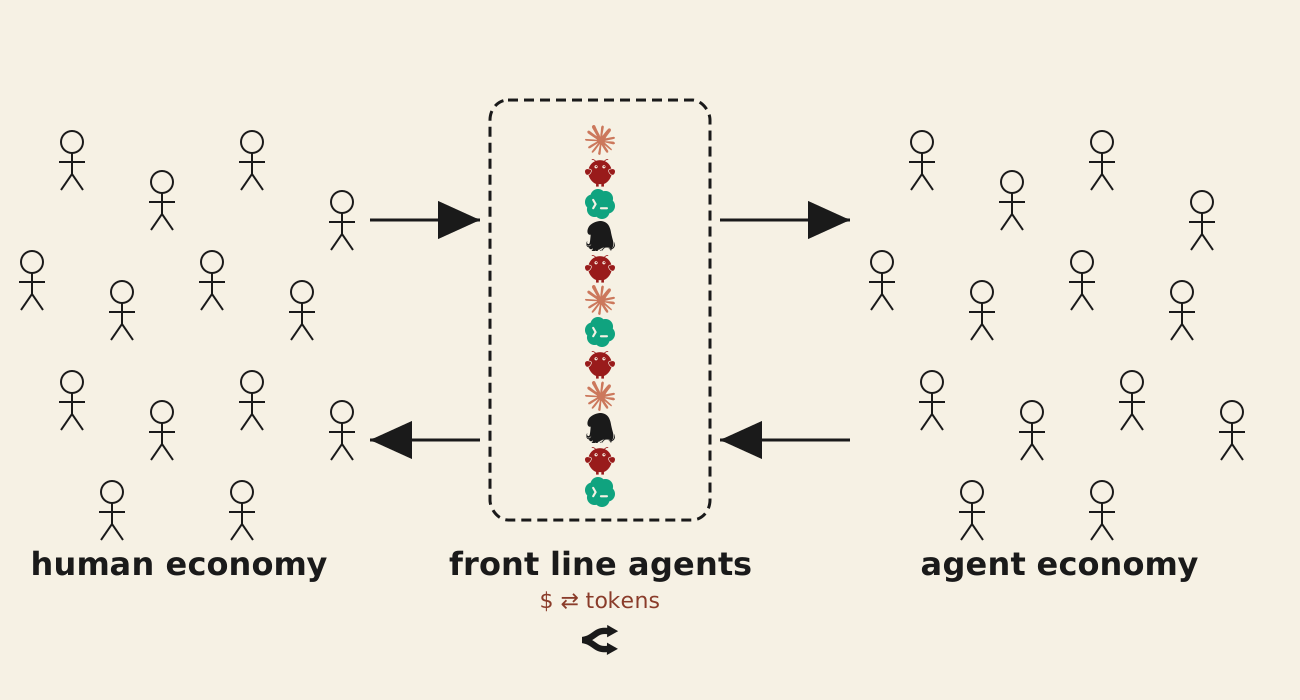
The agent economy is what happens when AI agents become workers, customers, and infrastructure. Three rough zones to picture.
The first is the human economy. The thing that has always existed. You and your work and your money. Has not gone anywhere.
The second is the front-line. The agents you talk to. One personal for your messages, your calendar, your inbox. One for work: your code, your CRM, your stack. You probably already have both. openclaw. ChatGPT. Claude. The slot in front of you.
The third is the agent economy proper. Agents calling other agents. Agentic organizations whose entire workforce is agents. Whole markets that humans never enter. Most of this does not exist yet.
Underneath all three zones sits a five-layer cake. Energy at the bottom. Then chips. Then infrastructure. Then models. Then applications at the top. Jensen Huang's framing. Every working application pulls all the way down to the power plant.
The players sort into four buckets.
Model labs build the engines. OpenAI, Anthropic, Google, Zhipu, Alibaba, DeepSeek, Moonshot.
Vehicle builders turn the engines into products for specific jobs. Cursor for code. ElevenLabs for voice. Suno for music. Runway for video. Bland and Retell for voice agents.
Infrastructure wires the agents to each other. OpenRouter for model routing. Mem0 for memory. Mount for insurance. Didit for identity. Coval for testing.
And the agents themselves. More autonomous. More addressable. More able to call each other.
That is the field. The rest of this is the map.